ISO 20022 as a Domain Model, Not an XML Problem
Listen to this article
Preparing audio…
FinTech Engineering
I start ISO 20022 work with the financial concept, not the XML tag. The standard is most useful as a governed vocabulary; an ingestion-only project can preserve syntax while losing meaning.
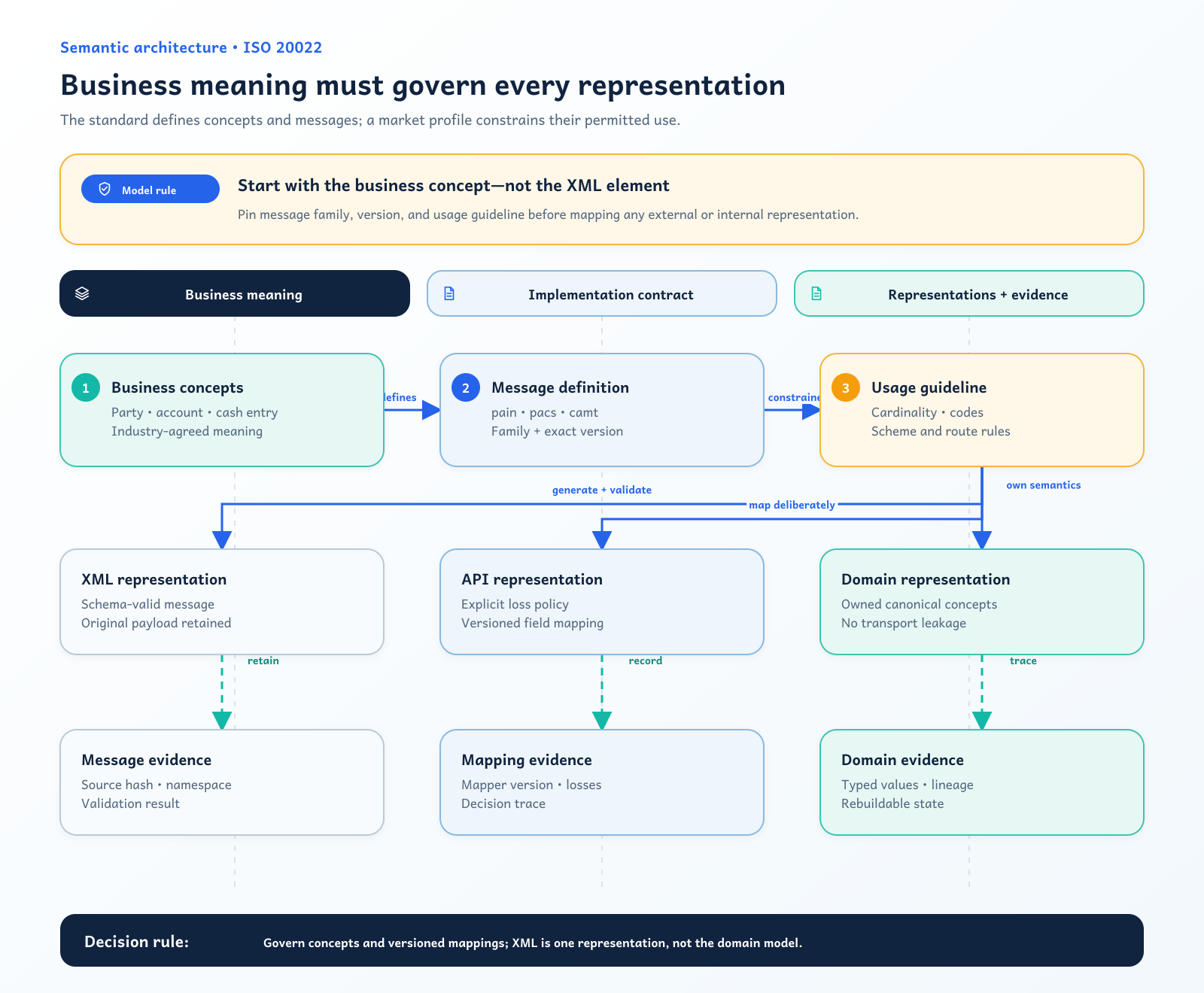
The standard is larger than a schema
The official ISO 20022 Business Model describes industry-agreed financial concepts and relationships used to derive message elements. The ISO 20022 FAQ clarifies that the standard defines a development methodology and repository, while XML and ASN.1 are generated syntaxes. The repository includes a Data Dictionary and Business Process Catalogue.
That distinction changes implementation. Dbtr, Cdtr, and EndToEndId are not valuable because their tag names are standardized; they are valuable because communities agree on their roles, cardinality, and business use in a particular message definition and usage guideline.
ISO 20022 does not provide one universal runtime payload. A message family, version, market practice, scheme rulebook, and bilateral constraints determine what is actually allowed. Saying “we support pacs.008” without the version and profile is incomplete.
Use a payment example
Imagine receiving a customer credit transfer. The platform may need the instructed amount, settlement amount, debtor, creditor, accounts, agents, remittance information, purpose, and identifiers. A naive mapper copies fields into a generic Payment object and drops unfamiliar structures into metadata. That makes the happy path easy and investigations impossible.
Here is how I would build the mapping catalog for every target field:
- source message and element path;
- semantic definition and multiplicity;
- profile/version in which it is valid;
- transformation or code-list rule;
- whether absence means optional, unavailable, or invalid;
- lossiness and preservation strategy;
- owner, tests, and effective date.
Preserve the original validated message under an appropriate retention and privacy policy. The internal model can optimize product workflows, but evidence must remain available when a mapping loses detail or a scheme interpretation changes.
Choose the canonical boundary carefully
A proprietary canonical model can reduce coupling across several rails, yet it can also flatten ISO 20022’s distinctions. “Party” is not enough when the source distinguishes ultimate debtor, initiating party, debtor, creditor, and ultimate creditor. A single reference field cannot safely absorb instruction ID, end-to-end ID, transaction ID, and UETR.
Adopt ISO concepts where they fit the product. Where the internal model intentionally differs, document the anti-corruption layer and loss. The ISO page on APIs and ISO 20022 explicitly notes that ISO business semantics can provide a consistent view for API exchanges; XML is not required at every internal boundary.
Version mappings as production code
Run old and new message versions in parallel during migration. Dispatch validation and mapping by declared namespace/profile, not by guessing from present fields. Store the mapper version with the resulting payment. Golden fixtures should cover optional parties, structured remittance, charges, return information, supplementary data, and external code sets—not only a minimal sample.
Schema validation catches structure. It does not prove compliance with a market-practice rule, a valid external code on that date, or a coherent business relationship. Add profile rules and semantic assertions. For example, validate that identifiers remain unique in their defined scope and that a return references the original transaction as required by the adopted scheme.
External code sets and market profiles evolve independently of application releases. Treat them as governed reference data with provenance, activation date, rollback, and monitoring. Do not fetch mutable code lists at transaction time without a controlled snapshot.
Preserve extensions without surrendering governance
Supplementary data exists for controlled extensions, not as a dumping ground. Define the extension owner, schema, namespace, consumers, and fallback behavior. A receiving party that does not understand an extension must still process or reject the message according to the applicable profile; internal teams should not assume an extension travels across every network.
When exposing JSON APIs, retain semantic names and constraints rather than mechanically converting XML tags. Publish an API contract that traces back to the ISO concept and profile. This makes it possible to adopt another serialization without reinterpreting the domain.
Operational controls
Measure validation failures by message version and rule, unmapped-field frequency, truncation, unknown code values, mapping latency, and reconciliation breaks traced to semantic loss. Provide an operator view showing original value, normalized value, mapping rule, and profile version.
For a version upgrade, run historical messages through both mappers and classify differences. Some changes are representation-only; others change a business interpretation and require product, operations, compliance, and counterparty sign-off.
The durable architecture
My design rule is to keep four layers visible: ISO business concepts, versioned message/profile definitions, serialization adapters, and the internal domain model. I test the mappings and preserve evidence at the edges. Starting with the business model keeps the durable question in view: what financial fact does this document communicate?
Before claiming support, publish a conformance statement naming the message definitions, versions, market-practice guideline, validation layers, unsupported elements, and extension policy. Give operations a searchable mapping view and a controlled way to quarantine—not silently repair—invalid messages. Revisit the statement whenever a code set, scheme guideline, or counterparty contract changes. “ISO 20022 compatible” without that scope is too vague to test.
Related reading
- Idempotency at Scale: More Than a Request Header
- Designing an Event-Driven Ledger That Auditors Can Trust


What decision would you make?
Add a question, a field note, or a respectful counterpoint. Comments are for signed-in members so the discussion stays useful and professional.