Payment Orchestration Without the Spaghetti
Listen to this article
Preparing audio…
FinTech Engineering
I start with one question: who can explain the payment when two processors disagree? Payment orchestration becomes valuable when it creates one truthful lifecycle across several processors—not when it merely wraps several APIs behind another endpoint.
Start with the ambiguity, not the routing rule
Assume a merchant submits a USD 180 order. The orchestrator sends an authorization to Processor A, but the connection closes before the response arrives. Retrying immediately with Processor B may improve availability—or create two valid authorizations. The transport failed; the financial outcome is unknown.
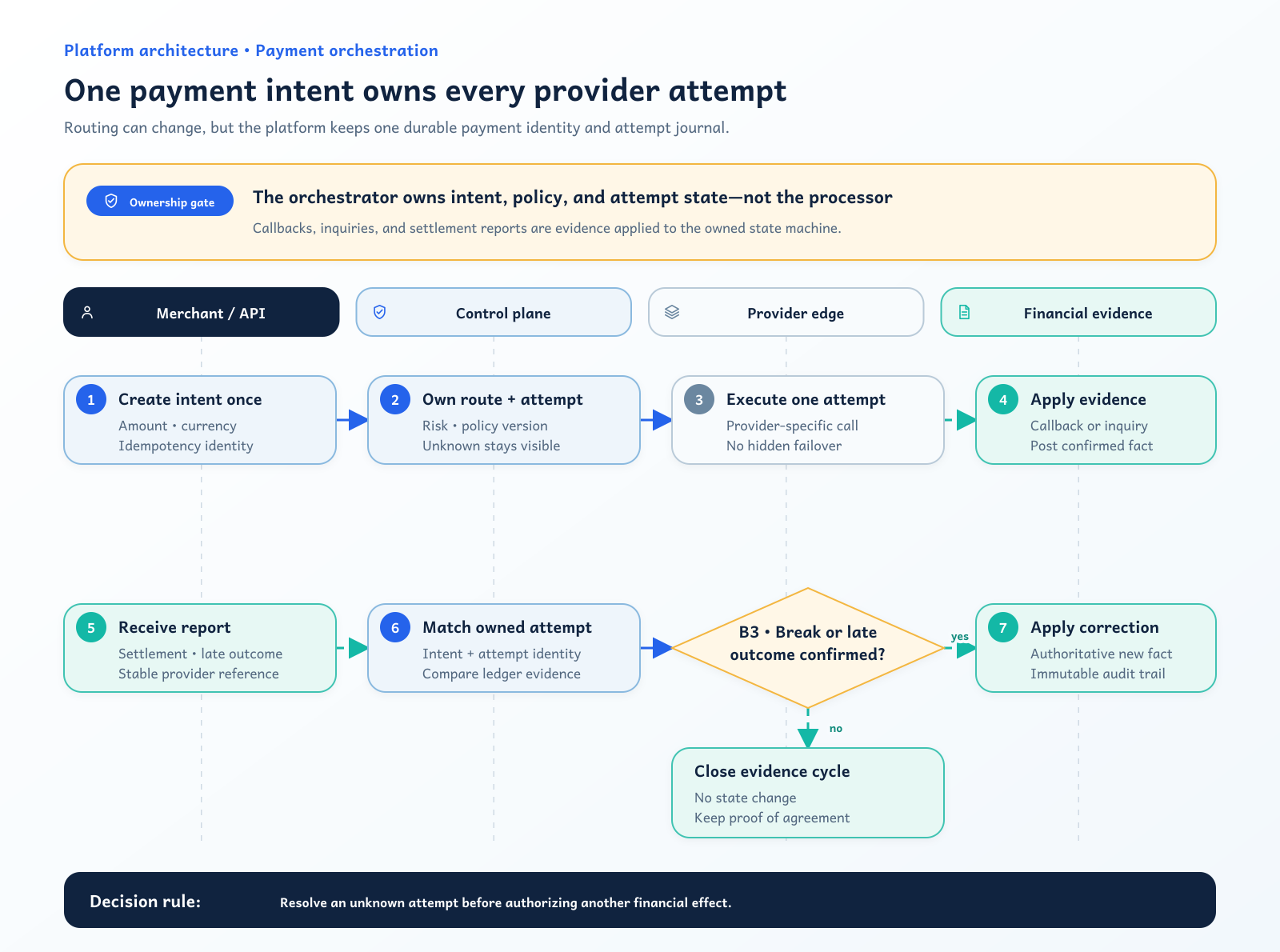
That distinction determines the architecture. A payment intent represents the merchant’s objective. Provider attempts represent executions of that intent. An attempt may be submitted, authorised, declined, unknown, reversed, or expired without forcing the intent into the same state. The orchestrator should never compress “we did not receive a response” into “the provider declined.”
Stripe’s official documentation illustrates both sides of this problem: its orchestration retries are constrained by processor capabilities and authentication outcomes, while its webhook documentation warns that events can be duplicated and delivered out of order. Stripe Orchestration was still described as a private preview when this article was reviewed in July 2026, so it is an example rather than a universal contract.
Separate policy, execution, and financial truth
Here is how I would model it, with four distinct responsibilities:
- Intent service: owns the merchant-facing identifier, amount, currency, capture mode, and permitted terminal states.
- Decision service: selects a route using declared inputs such as geography, scheme, cost, processor health, risk decision, and contractual constraints. It records the policy version and explanation.
- Provider adapters: translate canonical commands into provider-specific authorization, capture, void, and refund operations. They map provider references and error classes without owning business state.
- State and evidence store: atomically records attempts, transitions, idempotency keys, raw provider references, signed callback metadata, and the resulting ledger instruction.
This is a control plane with branches and feedback, not a five-stage pipeline. Risk may run before route selection, after a soft decline, or during step-up authentication. Capture may occur hours after authorization. A refund is a new financial operation, not a mutation of the original attempt.
Make cross-processor retry a guarded decision
Define an operation-specific retry matrix. A deterministic validation error is not retryable. A network failure before a request leaves the adapter may be safe to retry with the same provider and idempotency key. A timeout after submission is unknown and should move to status inquiry, callback waiting, or reconciliation—not automatic cross-provider execution.
A safe failover policy might say:
- retry Processor A once only when its API guarantees idempotent replay for the same merchant operation;
- do not route to Processor B while A is
unknownunless the product explicitly accepts a temporary double hold and has an automated reversal plan; - bind any approval or 3-D Secure result to the processor and attempt for which it is valid;
- cap attempts by payment intent, not independently inside every adapter.
The routing engine should return a decision record, not only a provider name: policy_version, evaluated facts, excluded routes, chosen route, and retry budget. This makes later disputes explainable and prevents a dashboard configuration change from silently rewriting history.
Treat callbacks as evidence, not commands
Verify callback signatures, persist the raw envelope, deduplicate on provider event identifiers, and then apply a legal state transition. If an authorised callback arrives after an attempt was marked unknown, it resolves uncertainty. If it arrives after a successful failover, it triggers a duplicate-authorization workflow; it must not overwrite the winning attempt.
The callback handler should acknowledge quickly and process asynchronously. The same principle appears in Stripe’s guidance to queue complex webhook work and handle duplicate delivery. Consumers should retrieve provider state when required because event ordering is not guaranteed.
Daily settlement reports form an independent control channel. Compare processor transactions, internal attempts, and ledger postings. This catches missing callbacks, operator changes, partial captures, and provider-side adjustments. Orchestration without reconciliation only centralizes uncertainty.
What to measure
Approval rate alone rewards aggressive retrying and can conceal customer harm. Operate the platform with a balanced scorecard:
- authorization rate by route, issuer region, and policy version;
unknownattempt rate and age;- duplicate authorization and reversal rate;
- callback delay and reconciliation breaks;
- incremental approval uplift net of fees, fraud loss, and false declines;
- manual interventions and time to explain a payment.
Chaos tests should inject a commit-before-timeout, duplicate callbacks, late success after failover, and a provider outage. The assertion is not merely that services recover. It is that one intent produces explainable attempts, balanced ledger effects, and a deterministic customer outcome.
The design rule
My design rule is simple: let the orchestrator own the payment intent and its attempt state machine, let adapters own protocol translation, and let the ledger own financial postings. I cross a provider boundary only through a recorded decision, and I resolve unknown outcomes before creating new money movement. That boundary removes the real “spaghetti”: not API variety, but contradictory ownership of the same financial fact.
Before launch, review each operation separately—authorization, capture, void, refund, and payout. Confirm its authoritative identifier, permitted transitions, retry evidence, callback behavior, reconciliation source, and customer-visible wording. Record who may change routing policy and how an emergency change is rolled back. A failover feature should not ship until operations can identify and reverse a duplicate outcome without database surgery.
Related reading
- Designing an Event-Driven Ledger That Auditors Can Trust
- Idempotency at Scale: More Than a Request Header


What decision would you make?
Add a question, a field note, or a respectful counterpoint. Comments are for signed-in members so the discussion stays useful and professional.