Platform Engineering Golden Paths Without Golden Cages
Listen to this article
Preparing audio…
Architecture
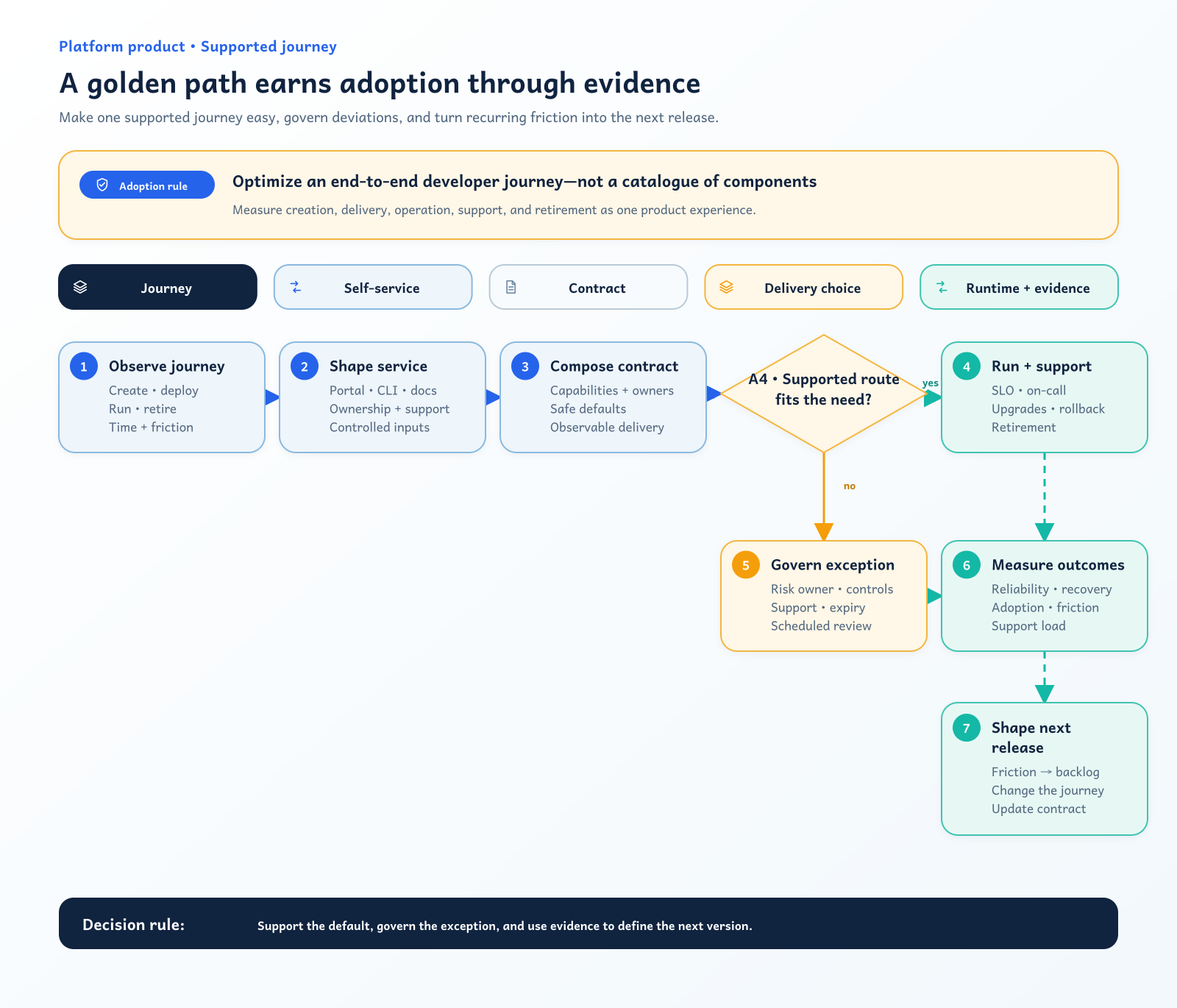
I define a golden path as a supported, observable route through common engineering work. It succeeds when teams choose it because it removes friction—not because an internal platform makes every alternative impossible.
Start with a journey, not a portal
Teams do not wake up wanting a developer portal. They want to create a service, ship a change, rotate a secret, expose an API, diagnose an incident, or retire a workload. A golden path should make one of those journeys faster and safer from request to operation.
The CNCF Platforms White Paper frames a platform as a product that curates capabilities for internal users. That product framing changes the first question from “Which tools should we centralize?” to “Which recurring user problem should we solve, for whom, and how will we know?” The white paper is living guidance; teams should record when they adopt a particular version or interpretation.
I start with user interviews and observation of the work. I measure current lead time, handoffs, failure/rework, cognitive load, and support demand, then pick a frequent, painful journey with enough commonality to standardize. A rare specialist workload is a poor first candidate.
Separate the path into contracts
A maintainable path combines several layers without hiding them:
- Experience: portal, CLI, documentation, examples, and discoverable ownership.
- Scaffolding: a template that creates a repository, metadata, tests, deployment definitions, and an initial service record.
- Capabilities: identity, secrets, build, deployment, networking, observability, data, and policy exposed through stable interfaces.
- Guardrails: automated checks and secure defaults with actionable feedback.
- Operations: runtime service levels, on-call ownership, upgrades, incident support, and decommissioning.
Backstage Software Templates provide one official example of controlled inputs and actions that scaffold and publish standardized project skeletons. A template is only the entry point. If generated services cannot receive platform updates, diagnose failures, or exit safely, the organization has created a one-time code generator rather than a supported path.
Version capability contracts independently from templates. Prefer composition: a team may use the standard build and observability capability while choosing a justified data store. Publish compatibility and deprecation windows. Test migrations on representative services before changing defaults.
Make safety the easiest choice
Good defaults remove decisions that add little product value: encrypted transport, baseline telemetry, ownership metadata, dependency scanning, deployment health checks, resource limits, and rollback hooks. Guardrails should explain the risk, show the failing evidence, and provide a repair path.
Do not confuse safety with uniformity. A single runtime, repository shape, or release process can become a constraint when workloads differ. The CNCF Platform Engineering Maturity Model describes progression toward self-service and standardized interfaces while warning that early approaches may offer too few customization options. Maturity is not the number of mandatory tools; it is the platform’s ability to meet user needs reliably through product practices.
Define a documented exception route. Ask for the use case, unmet requirement, risk owner, alternative controls, duration, support model, and review date. Time-box temporary exceptions. Feed repeated exceptions into the roadmap: they may reveal a missing capability or a path whose assumptions are too narrow.
An escape hatch without ownership becomes unmanaged risk. A path without an escape hatch becomes a golden cage.
Measure outcomes, not enrolment
Portal visits and template executions are activity metrics. A platform can have high enrolment because it is mandatory while users remain slow and frustrated.
Use a balanced scorecard:
- journey lead time and waiting time;
- change failure and recovery performance;
- reliability and security-control coverage;
- developer satisfaction and task success;
- support tickets and time to resolve;
- adoption by eligible teams, not all teams;
- exception frequency, age, and common causes;
- upgrade completion and exit cost.
Segment the results. A path may work for stateless APIs and fail for data-intensive or regulated workloads. Combine telemetry with interviews; instrumentation shows where users leave, while research explains why.
Set a hypothesis before launch: “For a standard API, the path will reduce median production onboarding from ten working days to two while preserving required controls.” Define the boundary and baseline. That is more useful than declaring the portal a success after one hundred registrations.
Run the platform as an internal product
Give every path a product owner, technical owner, service level, documentation, support channel, lifecycle policy, and roadmap. Treat teams as users rather than captive consumers. Publish incidents and breaking changes. Maintain examples that run in CI so documentation cannot drift indefinitely.
Create feedback loops at three levels:
- Inline: task-specific errors explain how to recover.
- Operational: telemetry identifies failure, latency, abandonment, and support hotspots.
- Product: interviews, exception reviews, and outcome metrics change priorities and contracts.
Prioritize by user outcome and systemic risk. A new dashboard may be less valuable than reducing a twenty-minute build queue or clarifying ownership during incidents.
A synthetic path: launching a standard API
Here is how I would model a synthetic “managed API” path. The user supplies ownership and data classification and receives a repository with service metadata, tests, CI, deployment descriptors, and observability. The pipeline verifies policy and deploys to a supported runtime. The catalogue shows ownership, dependency, health, and runbook links.
A team needing unusual network placement requests an exception. The platform cannot currently satisfy it, so the team uses an approved external pattern with named support and a review date. Three similar exceptions appear; product discovery confirms a reusable networking capability is warranted. The capability is added, migration support is offered, and the exception count falls.
That loop is the key: the platform learns from friction instead of treating deviation as disobedience.
The design test
My design rule is that a golden path should be easy to enter, safe to operate, inexpensive to upgrade, and possible to leave. It should expose composable contracts rather than conceal an opaque stack. Its success is measured in delivery and operational outcomes, not enforced adoption.
Build one end-to-end journey, instrument it, support it, and let evidence determine the next path. The goal is a platform product that earns trust—not a golden cage with better branding.
Related reading
- Architecture Decision Records That Teams Keep Using
- Modernizing Core Banking Without a Big-Bang Rewrite


What decision would you make?
Add a question, a field note, or a respectful counterpoint. Comments are for signed-in members so the discussion stays useful and professional.