Responsible AI Governance as an Engineering System
Listen to this article
Preparing audio…
AI Engineering
I consider responsible AI governance real only when every deployed use case has an owner, a traceable system record, evidence-based controls, and a tested way to stop or change it.
Policy is not yet a control
“Use AI responsibly” gives an engineering team no executable instruction. A control must identify the risk it addresses, the systems and actors in scope, the evidence required, who decides, when it runs, and what happens on failure.
The NIST AI Risk Management Framework 1.0 organizes work into Govern, Map, Measure, and Manage. That structure is useful because it connects institutional accountability with system context, evaluation, and treatment. NIST was working on a revision in 2026, so teams should record the framework version they map to rather than treating a living reference as timeless.
Governance is broader than model approval. A system may combine a foundation model, retrieval corpus, prompt, rules, tools, user interface, human review, and downstream workflow. A safe model can still participate in an unsafe process; a risky model can be constrained to a low-impact assistive role. Inventory the use case as an operational system.
Create one system record that joins the evidence
I start with a stable use-case ID before production access. Here is the system record I would require:
- accountable business owner and technical operator;
- intended purpose, users, affected people, and prohibited uses;
- jurisdictions, deployment role, and preliminary legal classification;
- model/provider, data sources, prompts, tools, dependencies, and versions;
- risk tier and rationale;
- evaluation, security, privacy, accessibility, and human-oversight evidence;
- approved limitations, monitoring thresholds, incident owner, and rollback plan.
Third-party models do not remove accountability. Track contractual restrictions, data handling, geographic processing, update policy, incident notification, and the provider version actually used. A silent provider update should trigger change assessment, not flow directly into a high-impact process.
Link artifacts rather than copying them into a governance spreadsheet. The inventory should point to source-controlled prompts, test reports, data lineage, threat models, approvals, deployment records, and incidents. The goal is a traversable evidence graph: from a production call to the approved configuration and from an identified risk to the controls that mitigate it.
Tier risk from context, not technology labels
“Generative AI” is not a risk tier. Map plausible harms using purpose, autonomy, data sensitivity, scale, reversibility, and effect on people. A summarizer for public documentation differs from an agent that can change a person’s payment limit.
Higher impact should demand stronger evidence and tighter runtime boundaries: independent validation, representative slice testing, least-privilege tools, approval for material actions, appeal routes, enhanced logging, rollout limits, and rehearsed rollback. The NIST Generative AI Profile, published in July 2024 and updated on its page in April 2026, identifies risks such as confabulation, information integrity, privacy, and misuse and suggests lifecycle actions. It is voluntary guidance, not a legal classification.
Risk tiers should also state residual risk. Passing controls does not make a system harmless; it makes the accepted exposure visible to the accountable decision-maker.
Separate legal applicability from internal assurance
The EU Artificial Intelligence Act, Regulation (EU) 2024/1689, establishes a role- and risk-based regime covering prohibited practices, high-risk systems, transparency, and general-purpose AI. Its applicability is phased and depends on geography, system classification, role, and use case. As of 19 July 2026, teams must verify the current application dates, Commission guidance, and professional legal advice before stating that a specific obligation applies.
Do not encode “EU AI Act compliant: yes/no” as a casual field. Record the legal analysis, role (for example provider or deployer), system category, applicable provisions, assessor, date, and assumptions. Keep internal responsible-AI controls distinct: an organization may choose stricter requirements than law, and voluntary NIST practices do not become statutory duties merely because both appear in the same control library.
Make approval a reproducible release gate
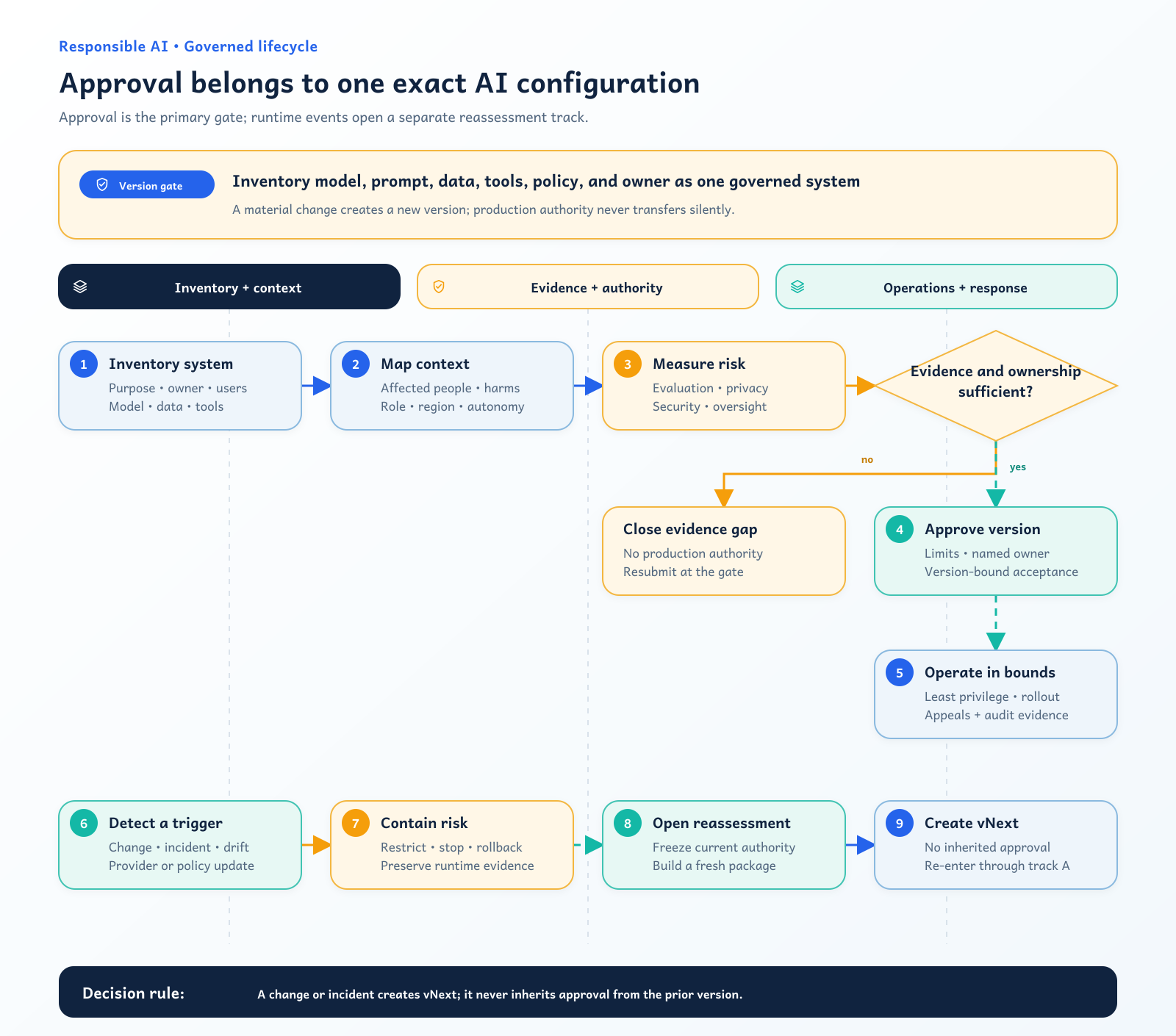
I would generate the approval package from the system record and the exact deployment candidate. It should include versioned evaluations, open findings, risk acceptance, use limitations, monitoring, and rollback. The approver must see what changed since the last approved release.
Classify changes before deployment. A copy edit may require basic checks; a new model, tool permission, jurisdiction, sensitive dataset, or autonomous action may require reassessment and independent review. CI/CD should verify that a valid approval covers the exact artifact versions. It should not allow a generic ticket to authorize later configurations.
Avoid approval theatre. A committee that receives a hundred-page document after implementation cannot provide effective challenge. Bring assurance specialists into mapping and test design, and define evidence templates that teams can produce continuously.
Close the loop with incidents and appeals
Monitor technical behaviour and human impact: prohibited tool attempts, unsupported claims, harmful content, override frequency, complaint/appeal outcomes, subgroup performance where lawful and appropriate, provider changes, drift, cost, and latency. Preserve privacy by collecting only the evidence required and controlling access and retention.
Thresholds need actions. A severe policy breach may disable a tool immediately; rising error on one slice may restrict rollout; a provider version change may route traffic to the last approved version. Incident handling must link affected calls to configuration, notify accountable roles, preserve evidence, correct harm where possible, and create new tests or controls.
Appeals and human overrides are not simply “noise.” They can expose a faulty policy, inaccessible interface, missing data, or unjustified automation. Feed those findings back into mapping, measurement, and risk acceptance.
The operating model
My design rule is that governance is a loop, not a launch checkpoint: inventory the whole system, map context and law, measure risks, approve a specific configuration, monitor use, manage incidents, and update the evidence.
The strongest test is operational: can the organization identify every affected deployment, explain why it was approved, show which controls ran, contact its owner, and roll it back quickly? If not, the policy has not yet become an engineering system.
Related reading
- AI Agents in Regulated FinTech: Control Before Autonomy
- RAG for Financial Operations: Evidence Over Eloquence


What decision would you make?
Add a question, a field note, or a respectful counterpoint. Comments are for signed-in members so the discussion stays useful and professional.