Tokenization Boundaries for PCI Scope Reduction
Listen to this article
Preparing audio…
FinTech Engineering
Tokenization can reduce where primary account numbers travel, but it does not automatically remove PCI DSS scope. I start by drawing the complete card-data flow, including security impact, administrative access, the vault, keys, integrations, and provider responsibilities. The checkout examples below are synthetic.
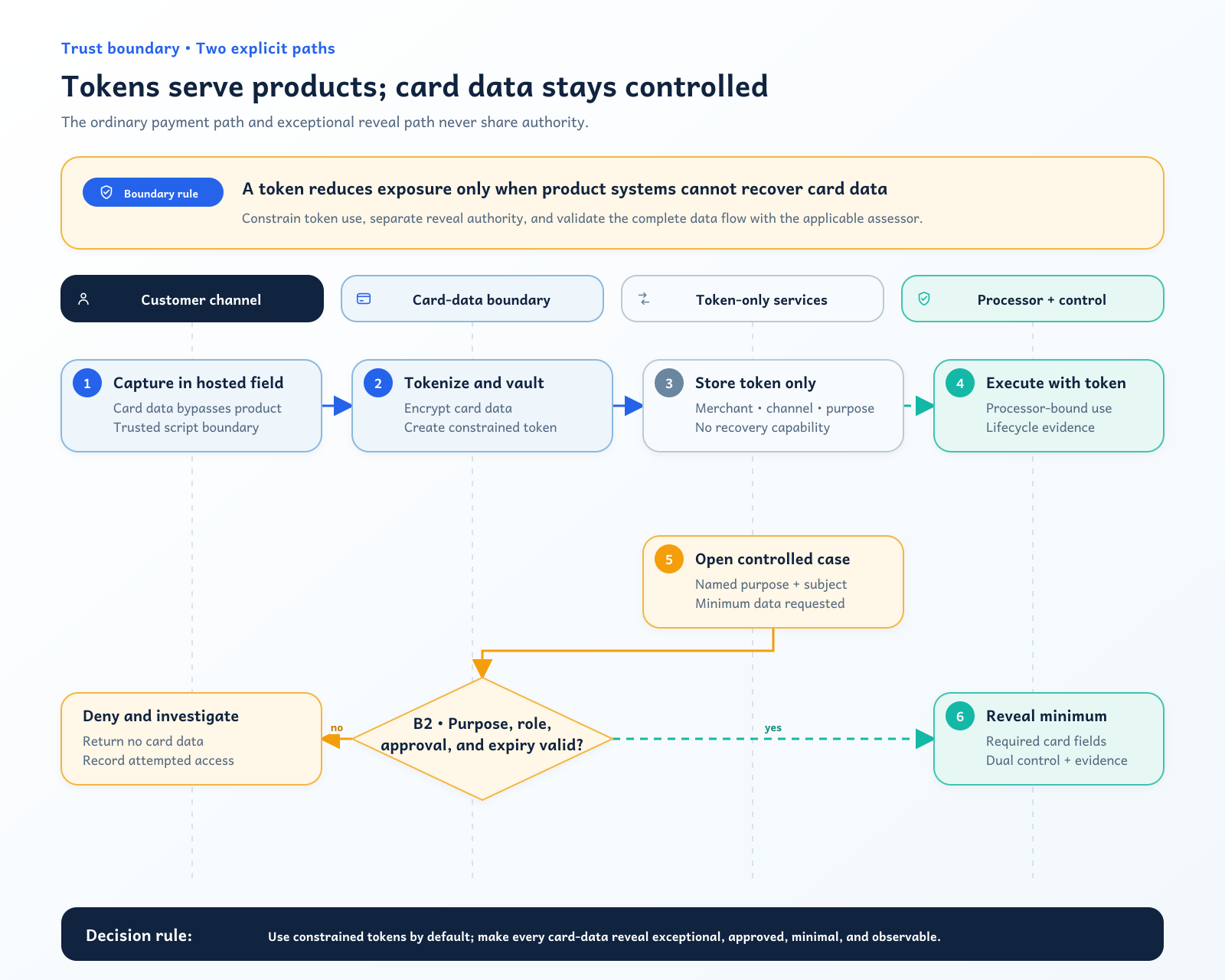
Define what a token is—and is not
Tokenization replaces a primary account number (PAN) with a surrogate value. A well-designed token reveals no PAN, has little value outside its permitted domain, and can be mapped back only through a protected token service or vault. It is not encryption: an encrypted PAN remains cardholder data, and possession of a decryption key restores it directly.
EMVCo’s Payment Tokenisation framework describes payment tokens with domain controls and lifecycle functions. Its current specification page listed version 2.4, published 9 July 2026, at research time. Network payment tokens, a processor vault token, and an internal alias solve different problems; document which one is used and where.
The PCI Security Standards Council’s Tokenization Guidelines explicitly state that tokenization does not replace PCI DSS requirements and that systems with access to PAN, tokenization components, and systems that can affect their security may remain in scope. The supplement dates from August 2011, so it should be read with the current standard and assessor guidance rather than treated as a complete modern scoping rule.
Draw the data flow before drawing the boundary
Inventory every path on which PAN can appear: browser or mobile capture, API request, memory, log, trace, queue, retry store, support tool, analytics export, backup, error report, and disaster-recovery environment. Mark token flows separately. Include administrators, deployment systems, secrets managers, vulnerability tooling, and network controls that can change the card-data environment.
A common lower-exposure design uses processor-hosted fields or a hosted payment page so PAN is submitted directly from the customer’s browser to a validated payment provider. The application receives a token. That can reduce exposure, but the page, scripts, redirects, and systems that can affect the payment form may still carry obligations. The exact self-assessment questionnaire and scope depend on the integration and acquiring relationship; obtain an assessor or acquirer determination rather than promising an outcome in architecture documentation.
PCI SSC identified PCI DSS v4.0.1 as a limited revision and retained 31 March 2025 as the effective date for the future-dated requirements. Pin the version used by the assessment and verify current PCI SSC publications before release.
Isolate the token service
Place PAN capture, token generation, vault storage, and detokenization in a restricted card-data zone. Ordinary product services should accept only tokens and last-four/brand metadata needed for user experience. Enforce at multiple layers:
- separate network and identity boundaries;
- least-privilege service identities, with no shared vault credential;
- authenticated encryption and managed keys separated from stored ciphertext;
- explicit allowlists for detokenization purpose and destination;
- immutable audit records for vault administration and reveal operations;
- PAN discovery scans on logs, object stores, queues, tickets, and data warehouses;
- retention and deletion rules for PAN, tokens, mappings, and backups.
Do not rely on developers remembering not to log a field. Reject PAN-shaped data at API boundaries that should be token-only, redact observability pipelines, and test error paths. Use synthetic test numbers outside production; never copy live card data into lower environments.
Make tokens domain-constrained
A token valid everywhere becomes a bearer secret with a different shape. Bind tokens to a merchant, channel, device, transaction type, or processor where the token scheme supports it. Separate display aliases from payment credentials. Rotate and suspend tokens through an explicit lifecycle, and propagate lifecycle events without exposing PAN.
Token format also matters. A format-preserving token can pass legacy validation and accidentally enter fields assumed to contain PAN. Tag values with a token type and provider; never infer semantics solely from length or prefix. Keep the mapping between internal payment method identifiers and external tokens versioned and auditable.
Control detokenization as an exceptional operation
Most application workflows should never reveal PAN. Where a business process genuinely requires it, require a narrowly scoped service identity, purpose code, destination restriction, rate and volume limit, approval for high-risk use, and complete audit trail. Return the minimum data for the shortest time and prevent it from entering logs or traces.
Monitor reveal attempts, denied purposes, unusual volume, new callers, vault administration, key access, PAN discovery findings, and token use outside its allowed domain. Include the vault and token provider in incident-response and business-continuity exercises.
Validate the claim about scope
Test the architecture with data-flow review, code and configuration inspection, PAN discovery, segmentation testing, access review, and provider evidence. Reassess after changes to checkout scripts, observability, support tooling, processor routing, backups, or deployment privileges. A new “harmless” analytics integration can reconnect an otherwise separated environment.
Scope reduction is a conclusion reached from evidence by the organization, its acquirer, and where appropriate a Qualified Security Assessor—not a feature flag. Architecture should say “designed to minimize PAN exposure,” then record the formal determination separately.
The architecture decision
Capture PAN in the smallest isolated zone, replace it with a clearly typed and domain-constrained token, block PAN at ordinary service boundaries, and make detokenization rare and observable. Tokenization is valuable because it reduces exposure and simplifies controls. It is dangerous when it becomes a slogan that hides remaining security dependencies. Design the complete flow, validate it against PCI DSS v4.0.1 and current guidance, and let evidence—not the presence of a token—determine scope.


What decision would you make?
Add a question, a field note, or a respectful counterpoint. Comments are for signed-in members so the discussion stays useful and professional.