Resilient Payment APIs: Timeouts, Retries, and Circuit Breakers
Listen to this article
Preparing audio…
FinTech Engineering
In a payment API, a timeout means “the caller does not know,” not “the payment failed.” My design rule is to separate transport recovery from financial truth and give every operation a durable identity that can be queried before repetition. The checkout cases below are synthetic.
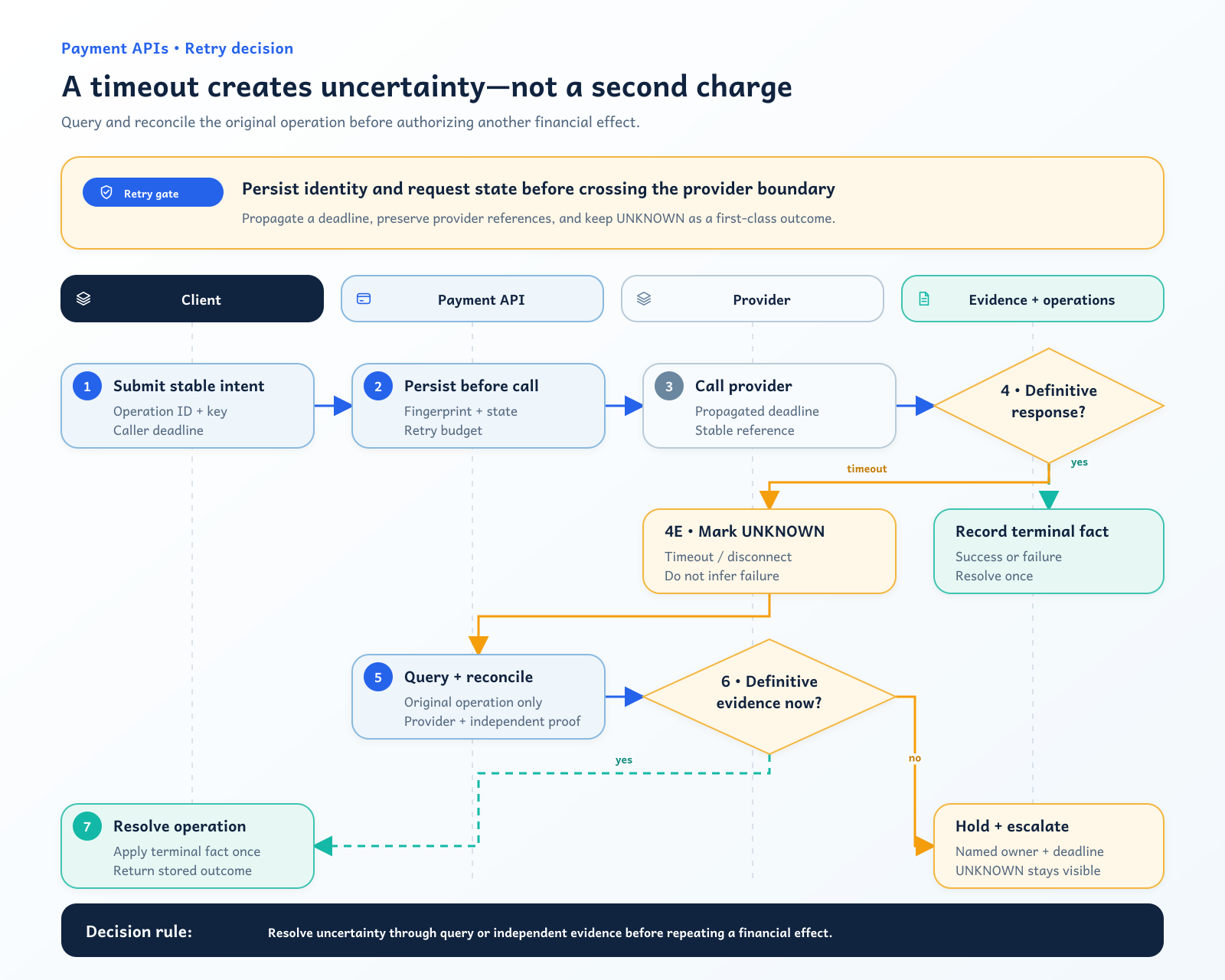
Classify the operation before choosing a retry policy
HTTP method names are only a starting point. RFC 9110 section 9.2.2 defines idempotent methods by their intended effect and says clients should not automatically retry a non-idempotent request unless they know its semantics are idempotent or can detect that the original was not applied.
A balance query is normally safe to repeat. Creating a payment is not safe unless the API binds repeated attempts to the same durable operation. A capture or refund may be conditionally repeatable with an idempotency key and state transition guard. A payout routed to an external rail may remain unknown until a later status message arrives.
Publish an operation matrix for every endpoint: side effect, idempotency scope, retryable failures, non-retryable failures, unknown outcome, status-query path, callback, and maximum decision age. This makes resilience a domain contract rather than a generic HTTP middleware setting.
Use one deadline and bounded attempts
Set an end-to-end deadline at the caller and pass the remaining budget downstream. Connection, TLS, request, and response timeouts must fit inside it. A timeout should be based on measured latency distributions and business tolerance, not a round number copied between services.
The Amazon Builders’ Library article on timeouts, retries, backoff, and jitter explains why retries can amplify overload and why exponential backoff, jitter, and retry budgets are needed. Apply those techniques at one controlled layer. If a client, gateway, service, and SDK each retry three times, one request can multiply into dozens of provider calls.
Limit attempts by both count and deadline. Respect provider rate limits. Use jitter to avoid synchronized retry storms. Do not retry validation failures, authentication failures, or explicit business declines. For a timeout after request transmission, prefer querying the operation by its internal and provider references.
Make unknown a first-class state
Return a durable operation_id as early as possible. Persist the request fingerprint, caller, state, and provider attempt before initiating an external effect. If the response is lost after the provider accepts the payment, a repeated request with the same idempotency key should return the existing operation, not create another.
Model at least received, processing, succeeded, failed_definitive, and unknown_external. The last state is not an error bucket. It has an owner, a next query time, a maximum age, and a recovery route through provider status, webhook, reconciliation file, or manual investigation.
Callbacks are evidence, not magic. Verify signatures, store the raw event, acknowledge quickly, deduplicate delivery, and apply an allowed state transition. A late “succeeded” event must be able to resolve unknown_external; it must not overwrite a terminal refund or another payment’s state.
Place the circuit breaker at the provider boundary
A circuit breaker protects callers and a struggling dependency; it does not decide whether money moved. The AWS circuit-breaker pattern describes closed, open, and half-open states with controlled recovery probes.
Implement the breaker in the provider adapter, scoped so one failing provider or operation does not disable unrelated traffic. When open, reject or queue new work according to product semantics. Do not reroute an in-flight unknown payment to another provider. A fallback is safe only before any provider may have accepted the effect, or after the first outcome is definitively negative.
Expose breaker state, rejected calls, probe results, and the age of unknown operations. Operational dashboards must separate transport health from financial completion.
Design the API response for recovery
For synchronous success, return the operation identifier, stable state, and provider reference when disclosure is appropriate. For accepted asynchronous work, use an explicit processing response with a status URL and retry guidance. For unknown outcomes, state that finality is pending; do not return a generic failure that invites the user to pay again.
Status queries should be strongly tied to the original caller and protected from enumeration. They should expose monotonic financial facts while allowing operational metadata to evolve. If a previous response is replayed for an idempotency key, make that behavior observable in headers or metadata.
Test failure at each boundary
Inject loss before connect, after connect, after request bytes are sent, after provider commit, and after your database commit. Test duplicate callbacks, out-of-order events, a breaker opening during a retry, provider recovery in half-open state, exhausted deadlines, and an operation that remains unknown beyond its service target.
Assert the number of external effects, not only HTTP responses. Monitor attempts per operation, retry amplification, deadline exhaustion, breaker state, duplicate-effect prevention, unknown-outcome age, status-query success, and reconciliation breaks.
The architecture decision
Build resilience around operation semantics. Bound time with one propagated deadline, retry at one layer with backoff and jitter, guard effects with durable idempotency, place circuit breakers at dependency boundaries, and represent uncertainty explicitly. The safest payment API is not the one that retries most aggressively; it is the one that can tell a caller whether to wait, query, retry, or stop without risking a second financial effect.


What decision would you make?
Add a question, a field note, or a respectful counterpoint. Comments are for signed-in members so the discussion stays useful and professional.