How a Payment Moves Through ISO 20022
Listen to this article
Preparing audio…
FinTech Engineering
When a corporate payment reaches a bank, the dangerous question is, “Has it been processed?” That word can mean the file arrived, the instruction passed validation, the debtor account was reserved, the interbank message was accepted, settlement completed, the creditor posted the beneficiary account, or the customer received a notification. Those are different events, owned by different systems.
I prefer to follow one synthetic payment end to end. A treasury team sends a supplier payment to its bank. The bank validates it, creates an interbank instruction, sends it through a clearing or RTGS service, and the creditor agent posts the beneficiary account. Reporting then returns enough evidence to reconcile the original intent with the financial outcome.
The familiar shorthand is pain.001 → pacs.008 → camt.054. It is useful, but it is not a universal recipe. The adopted scheme, market infrastructure, message version, and usage guideline determine the actual sequence and rules. My design rule is stricter: every transition needs its own proof, authority, and timestamp.
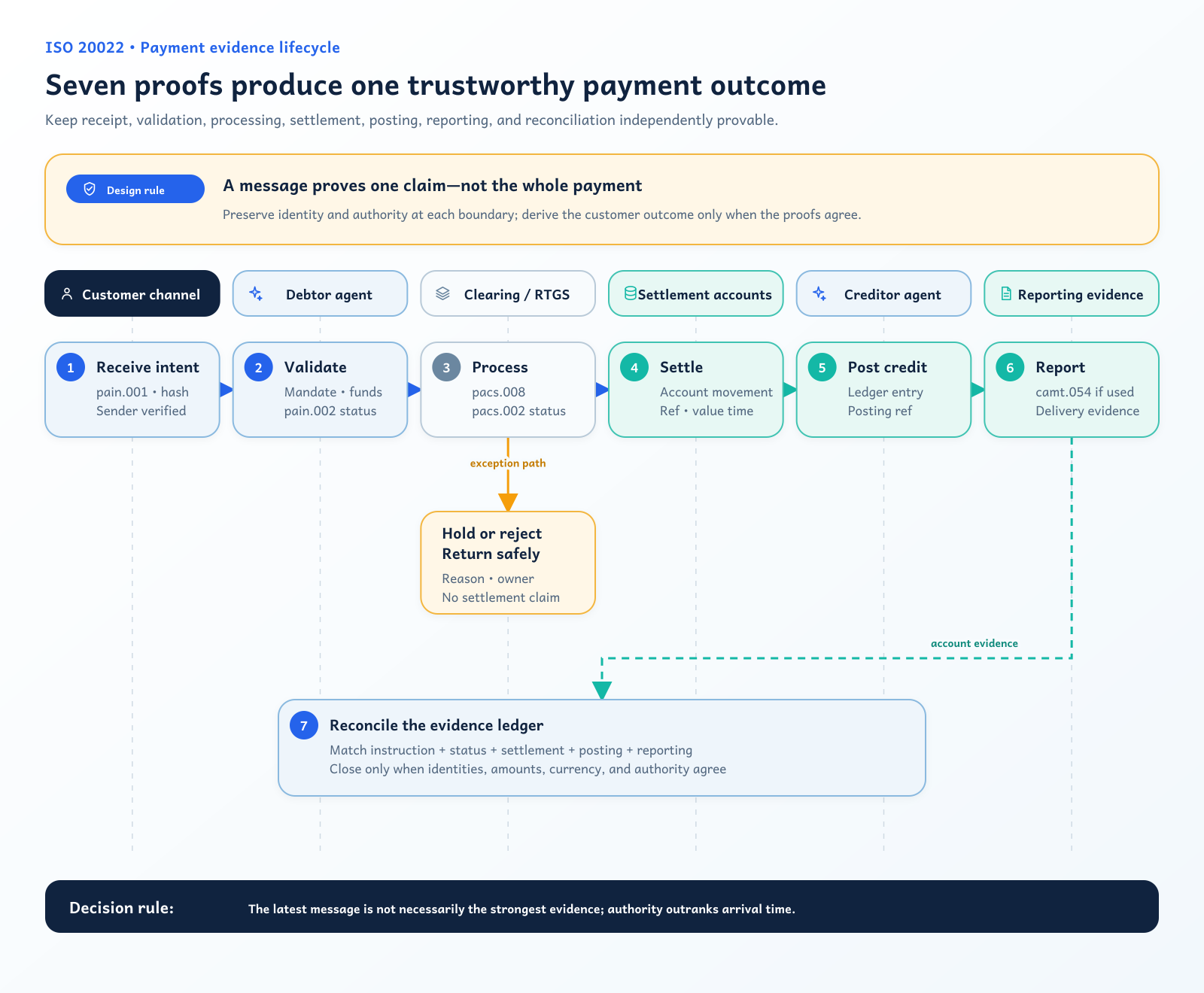
The lifecycle is an evidence ledger
I do not let one mutable payment_status column carry this journey. I keep an append-only evidence record and derive the customer-facing state from policy. That distinction is what prevents a late callback from turning “settled” back into “processing,” or a transport acknowledgement from becoming “paid.”
| Proof | Typical evidence | What it proves | What it does not prove |
|---|---|---|---|
| 1. Receipt | Channel ID, payload hash, authenticated principal | The bank received a specific instruction | Business acceptance or debit |
| 2. Validation | Rule-set version, decision, reason, pain.002 where used |
The instruction passed or failed the debtor agent’s controls | Interbank acceptance or settlement |
| 3. Interbank processing | pacs.008, business message ID, rail acknowledgement, pacs.002 where used |
The adopted route accepted, rejected, or held an instruction | Movement of settlement funds unless the profile says so |
| 4. Settlement | Rail or account-system reference, amount, value date, finality timestamp | The relevant participant-account movement occurred | Beneficiary-account posting |
| 5. Beneficiary posting | Creditor ledger entry and immutable posting reference | The beneficiary account was credited or rejected | Customer notification or end-to-end reconciliation |
| 6. Reporting | camt.054, statement event, delivery record |
A debit or credit entry was reported | That every upstream reference matches |
| 7. Reconciliation | Matched instruction, rail, ledger, and reporting identities | The expected financial evidence agrees | That history may now be overwritten |
The table is deliberately scheme-neutral. A usage guideline may use a different message, status vocabulary, or event order. The proof boundary remains useful because it asks the same operational question at every step: which system is authoritative for this claim?
ISO 20022 names contracts, not one payment rail
The ISO 20022 catalogue separates Payments Initiation, Payments Clearing and Settlement, and Cash Management. That structure is important. pain.001 is a customer-to-bank initiation message. pacs.008 is an FI-to-FI customer credit-transfer instruction. pacs.002 reports processing status. camt.054 is a bank-to-customer debit or credit notification.
These messages describe business communication. They do not create one global settlement system. The ISO implementation FAQ explains that an adopting community defines how it uses the standard. A domestic instant-payment scheme, an RTGS service, and a cross-border correspondent route can therefore constrain the same message family differently.
Before building an adapter, I write down the executable contract:
- exact message identifier and namespace;
- scheme or market-practice release;
- mandatory and forbidden elements beyond the XSD;
- code-list and character-set rules;
- duplicate scope and identifier lifetime;
- accepted status transitions;
- cut-off, settlement, return, and investigation rules.
That is why ISO 20022 as a Domain Model matters more than a library that serializes XML. A valid document can still be invalid for the selected route.
Step 1: pain.001 captures customer intent
In the synthetic case, a corporate treasury submits a payment initiation to its debtor agent. The pain.001 carries the requested execution, debtor and creditor information, amount, currency, remittance data, and references permitted by the bank’s channel profile.
Receipt is the first proof, not the outcome. The channel should assign an immutable intake identifier, retain the original payload or its governed evidence, authenticate the sender, and make retries idempotent. If a client times out after submission, the system must let it query the original request instead of encouraging a second payment.
The bank then validates more than XML. It checks entitlement, mandate, account state, funds or limits, party data, sanctions and compliance controls, cut-off policy, and route availability. Some profiles return customer-payment status through a pain.002; others expose equivalent status through an API or channel workflow. Whatever the transport, I model the result as received, accepted, held, or rejected with reason and timestamp.
Step 2: acceptance creates an interbank obligation
After acceptance, the debtor agent maps the customer instruction into its canonical payment model and selects a route. For a customer credit transfer between financial institutions, that route can produce a pacs.008 under the adopted clearing or network profile.
This mapping is not a field-copy exercise. The service must preserve end-to-end references, party roles, amount and currency meaning, charge arrangement, remittance, purpose, and agent chain. It must also record which source value produced each outbound value. That lineage is what makes an exception explainable later.
The CPMI’s updated 2026 harmonisation requirements address interbank payments, clearing and settlement, returns, and investigations, while preserving the need for consistent implementation across communities. I take the same approach internally: one payment aggregate can connect the journey, but every message and financial event keeps its own identity, version, and provenance.
Step 3: the rail validates, orders, and settles
The clearing or RTGS service validates the message against its own usage guideline. It can reject the instruction, accept it for later processing, queue it for liquidity, order it, or settle it according to its rules. A pacs.002 or rail-specific event may report part of this progression.
The key engineering rule is simple: a processing status is evidence of exactly the state it names. It is not automatically proof that central-bank money moved, that correspondent accounts were posted, that the beneficiary was credited, or that the customer statement reconciles.
I store the rail message identifier, business status, reason, settlement reference, value date, timestamp, source system, and usage-guideline version separately. Then I derive a payment-level state from an explicit policy. This avoids the common anti-pattern where the last arriving callback overwrites a more authoritative financial event.
A compact implementation can model the evidence like this:
create table payment_evidence (
  payment_id          uuid        not null,
  evidence_type       text        not null,
  source_system       text        not null,
  source_reference    text        not null,
  business_status     text        not null,
  occurred_at         timestamptz not null,
  recorded_at         timestamptz not null default now(),
  payload_hash        text        not null,
  profile_version     text        not null,
  primary key (source_system, source_reference, evidence_type)
);
The primary key is illustrative, not universal. The adopted route defines the real duplicate scope and identifier lifetime. The important property is that a retry either finds the same evidence or adds a new, separately identifiable event; it never silently edits financial history.
Payment infrastructure documentation makes this profile boundary concrete. The Fedwire ISO 20022 technical FAQ, for example, directs participants to the service-specific format and validation documentation. Supporting “ISO 20022” without naming the market profile is not a testable claim.
Step 4: beneficiary credit is another financial event
Once the creditor agent receives the instruction and the settlement evidence required by its operating model, it validates the beneficiary account and applies its posting policy. The beneficiary-credit timestamp can differ from the interbank-settlement timestamp. Legal finality, availability of funds, screening, account restrictions, and local operating rules all matter.
The platform therefore needs separate facts for:
- instruction accepted by the debtor agent;
- interbank instruction accepted by the rail;
- settlement completed under the rail or account model;
- creditor agent received the instruction;
- beneficiary account posted or rejected;
- customer notification produced;
- reconciliation completed.
Collapsing these into SUCCESS is convenient until the first dispute. After that, the missing distinctions become an operational and accounting problem.
Step 5: camt.054 reports a debit or credit
A camt.054 can notify a customer of a debit or credit entry. In this example, the creditor agent uses it to report the beneficiary credit, while a debtor-side notification can report the debit under the applicable service.
The European Payments Council recommendation on customer reporting emphasizes ISO 20022 cash-management reporting and reference continuity for reconciliation. That is the real value of structured reporting: the notification should carry enough stable identity to match the booked entry to the instruction and interbank evidence.
camt.054 is not a magic close signal. A notification can be duplicated, delayed, corrected, or unmatched. The reconciliation service checks identifiers, account, amount, currency, debit or credit indicator, booking and value dates, and any scheme-specific references. It closes the payment only when the expected financial evidence agrees.
The broader control pattern is explained in Reconciliation by Design: exceptions must remain visible, and corrections must produce new evidence rather than rewrite history.
Failure paths I test before the happy path
I design these cases before launch:
- Duplicate pain.001: return the existing payment identity within the idempotency scope; do not create another obligation.
- Channel timeout after acceptance: expose queryable state and do not tell the client to resend blindly. The uncertainty model in Resilient Payment APIs applies here.
- Business rejection after transport acceptance: retain both events. The transport worked; the payment did not pass the business rule.
- pacs.008 accepted but settlement delayed: show
accepted / settlement pending, notpaid. - Settlement recorded but beneficiary posting fails: open a governed exception with the creditor-side reason and ownership.
- camt.054 arrives twice: deduplicate the notification without suppressing a genuine later correction.
- References disagree: stop automatic closure and investigate; never force a match using amount alone.
Each failure has an owner, a deadline, a safe retry rule, and a customer-facing explanation. A payment platform is not reliable because every message succeeds. It is reliable because uncertainty cannot silently become a second debit or a false completion.
My implementation checklist
Before enabling a payment route, I ask:
- Which business event does each message represent?
- Which exact usage guideline and version apply?
- What proof authorizes the next transition?
- Which system owns receipt, validation, settlement, posting, notification, and reconciliation?
- Which identifiers survive every transformation?
- How long does each idempotency and duplicate key remain valid?
- Can a late event move state backward or overwrite stronger evidence?
- What does the customer see during a timeout, hold, or partial completion?
- Can operations explain the payment without reconstructing it from raw XML?
The durable design is not a straight line of acronyms. It is a chain of explicit business contracts and evidence. pain.001 captures intent, pacs.008 carries the interbank customer transfer, status messages report defined processing outcomes, the settlement system records its financial result, the creditor agent records beneficiary posting, and camt.054 supports customer reporting. Reconciliation joins those facts. Only then should the platform say the payment is complete.
References
- ISO 20022 — Message Definitions
- ISO 20022 — Frequently asked questions
- CPMI — Harmonised ISO 20022 data requirements, updated 2026
- European Payments Council — Customer-reporting recommendation
- Federal Reserve Financial Services — Fedwire ISO 20022 technical FAQs
- Swift — ISO 20022 for payment instructions


What decision would you make?
Add a question, a field note, or a respectful counterpoint. Comments are for signed-in members so the discussion stays useful and professional.