pacs.008 vs pacs.009: Customer, FI, and Cover Transfers
Listen to this article
Preparing audio…
FinTech Engineering
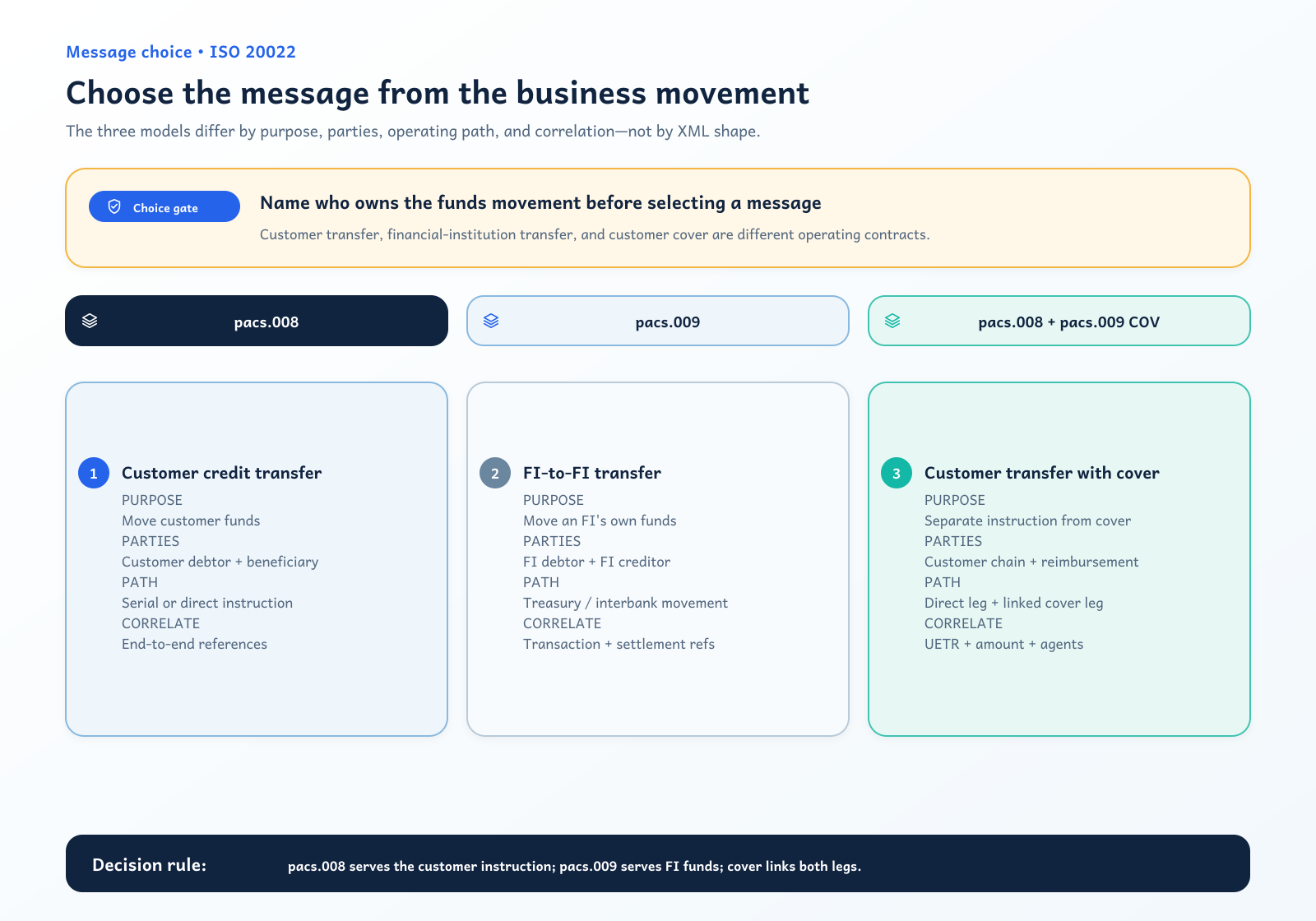
When I compare pacs.008 with pacs.009, I do not start with their XML. I start with the financial reason for moving value. A pacs.008 carries a customer credit-transfer instruction between financial institutions. An ordinary pacs.009 carries a credit transfer in which the debtor and creditor are financial institutions. A pacs.009 COV is a specific cover use of pacs.009: it moves funds for one customer transfer already sent separately in pacs.008.
That distinction matters when a platform must choose a route, screen the right parties, correlate two message legs, or explain why an instruction arrived before its cover funds. A wrong choice changes the represented business function and can create routing, compliance, liquidity, and reconciliation failures.
The short answer
I use this decision table before discussing fields:
| Business movement | Message model | What travels |
|---|---|---|
| A customer pays another customer through a serial correspondent chain | pacs.008 | Customer instruction and settlement path advance through the same chain |
| One financial institution transfers its own funds to another | pacs.009 | FI-to-FI transfer, such as an eligible treasury or liquidity movement |
| A customer instruction is sent directly while correspondents provide settlement | pacs.008 plus pacs.009 COV | pacs.008 carries the Direct customer instruction; pacs.009 COV carries linked cover funds |
The official ISO 20022 message catalogue names pacs.008 FIToFICustomerCreditTransfer and pacs.009 FinancialInstitutionalCreditTransfer. The CPMI harmonised requirements include both in the core cross-border credit-transfer set and make “use the appropriate message for a particular business function” the first fundamental requirement.
The rule is therefore not “customer-facing channel means pacs.008” or “bank network means pacs.009.” Both messages travel between financial institutions. The difference is whose underlying credit transfer the message represents and, for cover, whether the message is the customer instruction or the funding leg.
Name the version and profile
“We support pacs.008” is incomplete. As of this review, the global catalogue lists pacs.008.001.14 and pacs.009.001.13. The February 2026 CPMI technical annex models pacs.008.001.13 and pacs.009.001.12. The April 2026 PMPG cover guidance discusses the CBPR+ pacs.009.001.08 COV usage guideline.
These are different layers and release cycles: the global message definition, a harmonised cross-border data model, and a network market-practice profile. The ISO 20022 implementation FAQ notes that implementation depends heavily on the adopting community, so schemes can constrain the same base message differently.
For every integration, I record:
- message identifier and namespace;
- market-practice or scheme usage guideline and release;
- permitted settlement methods and agents;
- validation rules beyond XSD;
- supported identifiers, code-list snapshot, and character rules;
- bilateral restrictions and activation date.
Schema validity proves structure against one XSD. It does not prove that the message is valid for the selected route or profile. The deeper implementation model is covered in ISO 20022 as a Domain Model; here the important point is that routing must select a versioned business contract, not only a serializer.
Serial: pacs.008 follows the customer-payment chain
Consider a synthetic EUR 250,000 supplier payment. A debtor instructs Bank A to credit a supplier at Bank C. Bank A has no direct settlement relationship with Bank C for the route, so Bank B acts as an intermediary.
In the serial model, Bank A sends pacs.008 to Bank B, and Bank B forwards the customer credit transfer to Bank C according to the applicable profile and account relationships. The customer parties, agents, amount, remittance, purpose, and transaction identifiers remain part of the customer-payment instruction as it advances. The Swift CBPR+ customer-payment material explicitly separates this serial pacs.008 method from the cover method.
I represent each hop as part of one end-to-end payment but not as one database update. Each hop can be received, validated, held, rejected, settled, or forwarded at a different time. The platform keeps the end-to-end identity and the current instructed/instructing agents visible while preserving prior-agent evidence required by its profile.
Serial flow is simpler to correlate because instruction and settlement follow the same chain, but it is not automatically faster or safer. Every intermediary adds a boundary for cut-off times, liquidity, screening, fees, transformation, and exceptions.
FI-to-FI: ordinary pacs.009 represents a bank transfer
Now remove the supplier. Bank A wants to transfer its own funds to Bank C for an eligible treasury purpose. The debtor and creditor are financial institutions; there is no underlying customer credit transfer to fund. This is the ordinary pacs.009 business function.
A pacs.009 can pass through intermediaries and its settlement can fail, but it does not become customer payment data because an operator attaches a customer reference. Conversely, a pacs.008 is not the right treasury message merely because its XML can carry agents and amounts.
This boundary matters in the canonical model. I keep customer_credit_transfer and financial_institution_credit_transfer as separate domain concepts with separate allowed parties, purposes, routing policies, and validations. A generic credit_transfer table can share infrastructure, but it must not erase the business type.
Cover: one payment, two linked paths
Return to the supplier payment. Bank A can send the pacs.008 customer instruction directly toward Bank C while using reimbursement agents to move the funds. The customer instruction and settlement now travel on different paths:
- The Direct leg is the pacs.008 from the debtor-agent side toward the creditor agent.
- The cover leg is one pacs.009 COV through the correspondent or reimbursement chain.
The Swift ISO 20022 Programme User Handbook documents the pacs.008 settlement method and uses COVE to indicate settlement through a covering pacs.009. The current PMPG Cover Payments guideline is stricter about purpose: pacs.009 COV covers one separately sent pacs.008 customer credit transfer. It is not an alternative to pacs.008, and an ordinary pacs.009 must not be used to disguise that customer-cover function.
The COV usage is identified by the underlying customer credit-transfer component. That component copies selected information from the pacs.008, including the customer parties required by the profile, and the guidance says those elements must remain unchanged through the cover chain. Intermediaries need that underlying information for screening; replacing it with placeholders or unrelated data defeats the transparency the variant was designed to provide.
The Direct and cover legs need deterministic correlation. PMPG guidance describes the UETR as linking pacs.008 and pacs.009 COV and says the related camt.054 credit notification should reference it. I also correlate message identifiers, amount, currency, agents, value date, and the immutable customer-data fingerprint. The UETR is evidence, not permission to ignore contradictory fields.
Model two states, then derive the customer outcome
A cover payment is where weak state models become dangerous. Receiving the Direct pacs.008 does not mean the cover funds have settled. Receiving a pacs.009 COV does not prove that the beneficiary was credited. A transport acknowledgement is not a business acceptance, and a credit advice is not the same thing as end-of-day reconciliation.
I keep at least two linked state machines:
- instruction state: received, validated, held, accepted, rejected, cancelled, or completed under the adopted profile;
- cover state: expected, received, screening, settled, delayed, rejected, returned, or unmatched.
The customer-facing state is derived from policy and evidence across both. Whether Bank C credits before cover receipt is not a universal ISO 20022 rule; it depends on legal interpretation, scheme rules, account relationships, credit policy, and the selected service. The platform must record that decision instead of burying it inside an adapter.
PMPG guidance calls for delay or rejection of the cover leg to be communicated quickly and identifies pacs.002, tracking updates, cancellation, return, and investigation paths depending on the situation. For the API side, I apply the same uncertainty rule described in Resilient Payment APIs: a timeout means the caller does not know, not that money did not move.
Failure modes I test before launch
The happy path is easy to draw. These are the cases that reveal whether the model is correct:
- Ordinary pacs.009 used as cover. The funds arrive without the required underlying customer context. Stop and investigate; do not infer a COV variant from an operator note.
- pacs.009 COV has no matching pacs.008. Hold it as unmatched evidence, alert operations, and follow the applicable status or investigation process.
- Direct and cover data disagree. Compare UETR, amount, currency, agents, value date, and the underlying customer fingerprint. Never silently overwrite one leg with the other.
- Direct arrives before cover. Represent “instruction received, settlement pending” explicitly. Apply the institution's approved credit policy.
- Cover settles after Direct rejection or cancellation. Route the case into governed exception handling; do not post it as a new unrelated FI transfer.
- A retry creates duplicate legs. Deduplicate each message in its defined scope and enforce the one-pacs.008-to-one-pacs.009-COV relationship for this use case.
- A router switches serial to cover after submission. Reject the mutation. A different settlement model creates new instructions and evidence; it is not an invisible adapter fallback.
Ledger postings should follow confirmed financial events, and corrections should be new entries rather than edits to history. Designing an Event-Driven Ledger explains that accounting boundary in more detail.
My implementation checklist
Before enabling a route, I ask:
- Is the underlying movement a customer transfer or an FI's own transfer?
- If customer-related, are instruction and settlement serial or separated into Direct and cover paths?
- Which exact message version and usage guideline govern the route?
- Does pacs.008 declare the permitted settlement method for that profile?
- If cover is used, is there exactly one corresponding pacs.009 COV with preserved underlying customer data?
- Which identifiers and financial fields must match across both legs?
- Which system owns instruction state, cover state, beneficiary-credit policy, and reconciliation evidence?
- What happens when either leg is delayed, rejected, duplicated, returned, or unmatched?
- Can operations explain the payment without reading raw XML across several systems?
The durable design rule is simple: choose by business function, then make the route a first-class domain decision. pacs.008 is the customer instruction. pacs.009 is the FI transfer. pacs.009 COV is the linked cover leg for one separately sent pacs.008. Once those meanings are explicit, mapping, status processing, reconciliation, and incident handling become testable instead of interpretive.
References
- CPMI — Harmonised ISO 20022 data requirements, updated report
- CPMI — Harmonised ISO 20022 data models, technical annex
- ISO 20022 — Message Definitions catalogue
- ISO 20022 — Frequently asked questions
- PMPG — Cover Payments Market Practice Guideline, version 4.1
- Swift — CBPR+ Customer Payments
- Swift — ISO 20022 Programme User Handbook


What decision would you make?
Add a question, a field note, or a respectful counterpoint. Comments are for signed-in members so the discussion stays useful and professional.