UAEFTS Explained: Engineering Real-Time Settlement
Listen to this article
Preparing audio…
FinTech Engineering
UAEFTS is easy to describe as “the UAE’s RTGS.” That description is correct, but it is not enough to design a production integration. The engineering problem begins when a bank must turn a customer or treasury instruction into an individually settled transfer, manage liquidity while the instruction is in flight, distinguish settlement from beneficiary posting, and prove the outcome later.
My rule is simple: never let one generic SUCCESS hide the boundaries between instruction acceptance, queueing, settlement in central-bank money, participant confirmation, and account posting.
UAEFTS is settlement infrastructure, not a payment API
The Central Bank of the UAE describes UAEFTS as the country’s Real Time Gross Settlement system, owned, hosted, and managed by CBUAE. It has operated since 2001 and transfers funds between participating banks and financial institutions through their accounts at the central bank.
“Real time” means instructions are processed continuously during the system’s operating window. “Gross” means transfers are settled individually rather than offsetting debits and credits into a net position. Those properties define a financial-market infrastructure. They do not mean every channel, compliance decision, core-banking posting, or beneficiary notification completes in one synchronous request.
CBUAE classifies UAEFTS as a Large-Value Payment System, while its other infrastructures serve retail-payment purposes. Yet UAEFTS activity is not limited to a small set of exceptional corporate payments. The CBUAE Annual Report 2025 reports 114.9 million retail transfers worth approximately AED 9.9 trillion and 865,708 institutional transfers worth approximately AED 14.5 trillion through UAEFTS in 2025. At that scale, operational correctness matters as much as raw throughput.
Follow one transfer through the boundaries
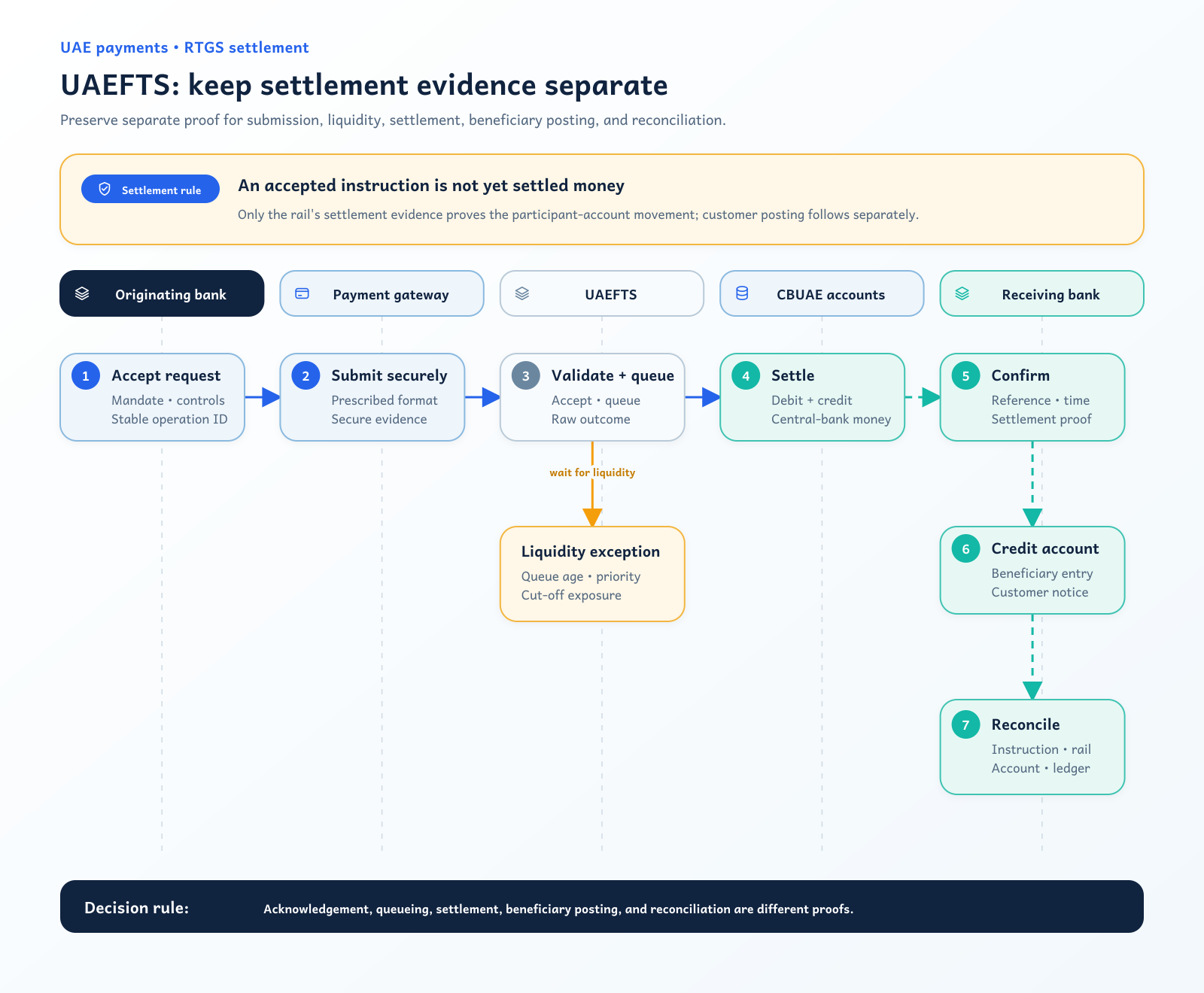
I model an outbound UAEFTS transfer as a sequence of explicit proofs.
1. The participant accepts the instruction
The originating institution authenticates the caller, validates the account and mandate, applies sanctions and financial-crime controls, checks product and participant rules, and reserves a durable internal operation identifier. Customer acceptance proves that the institution has taken responsibility for processing the request. It does not prove that UAEFTS has received or settled it.
The operation should become immutable enough to retry safely: amount, currency, debtor, creditor, value date, purpose and permitted remittance data, initiating channel, approvals, and the relevant external references. Corrections should create a controlled replacement or cancellation path rather than silently changing a submitted instruction.
2. The gateway submits through the certified channel
CBUAE states that UAEFTS supports straight-through processing using prescribed formats over SFTP. Participants can also enter transactions through the restricted Transactions and Enquiry Portal, or TEP. I therefore keep the payment domain separate from the transport adapter.
The adapter serializes the approved instruction into the required market format, signs or packages it as required, sends it through the certified connection, and records a content hash, transmission time, file or message reference, and technical acknowledgement. A successful upload is transport evidence—not settlement evidence.
3. UAEFTS validates, orders, or queues the transfer
The rail may reject an invalid request or queue an otherwise valid instruction for processing. The public CBUAE description says participant requests are queued for immediate action and settled continuously according to the governing rules. The bank’s state model should therefore preserve at least submitted, technically_acknowledged, accepted_for_processing, queued, settled, rejected, and unknown as distinct concepts, even if the exact external codes come from the applicable UAEFTS specification.
Queueing deserves special treatment because an RTGS system consumes liquidity transfer by transfer. It is not a harmless synonym for “pending.” A growing queue can indicate a participant liquidity problem, a counterparty pattern, an operational incident, or an approaching cut-off risk.
4. Settlement moves balances at CBUAE
The decisive interbank event is the individual debit and credit across participant accounts held with CBUAE. Once the rail reports settlement under its rules, the originating institution must stop treating the instruction as a retryable outbound command. A second submission is a second financial instruction unless the scheme explicitly identifies it as the same operation.
That is why idempotency must span the business command, the generated UAEFTS instruction, the outbound artefact, and the returned evidence. A timeout after submission is an unknown outcome. The correct response is to query or reconcile the original reference—not create a replacement payment because the caller did not receive an answer. The same principle appears in my article on resilient payment APIs.
5. Confirmation and beneficiary posting complete different obligations
CBUAE says the system sends confirmation to affected participants after processing. The receiving institution still has its own work: correlate the incoming transfer, run the controls required for that context, post the beneficiary account, notify the customer, and expose the entry through statements or transaction history.
Interbank settlement and beneficiary credit should therefore have separate timestamps and references. Customer support needs to know whether funds settled to the receiving institution but remain unmatched or unposted. Finance needs the same distinction to reconcile settlement-account movement against customer-account entries.
Liquidity is part of the application design
RTGS integrations fail when teams treat liquidity as somebody else’s dashboard. Each individually settled debit changes the participant’s available position. A payment service needs visibility into queued value, settlement-account capacity, urgent-payment priority, expected incoming funds, cut-off exposure, and aged instructions.
CBUAE’s Intraday Liquidity Facility gives eligible UAEFTS participants access to collateralised dirham funding to manage unforeseen disruption or gridlock. That facility is a liquidity-management tool, not an automatic application retry. The bank still needs an operating decision: which queued instructions are urgent, which collateral and approvals are available, who may invoke a facility, and how every decision is recorded.
I expose liquidity as an explicit dependency to orchestration. The payment engine may request priority, hold a lower-priority instruction, or escalate an aged queue item, but it must not manufacture settlement capacity or hide the reason for delay.
Build an evidence ledger beside the money ledger
For every UAEFTS instruction, I retain an append-only evidence chain:
- the approved business instruction and its payload fingerprint;
- the market-format artefact actually transmitted;
- technical acknowledgements and delivery attempts;
- UAEFTS processing status with the raw code and interpretation version;
- settlement reference, timestamp, amount, currency, and affected participant accounts;
- receiving-side posting or return evidence when available;
- operator actions, investigations, and corrections.
The money ledger records financial postings. The evidence ledger explains why those postings exist and which external event justified each one. They are linked, but one should not overwrite the other.
This makes reconciliation deterministic. At minimum, I reconcile four populations: approved outbound instructions, artefacts sent, UAEFTS outcomes, and settlement-account entries. On the inbound side, I reconcile rail confirmations to beneficiary postings and exceptions. A perfectly matched set can still be incomplete, so control totals must cover count, value, currency, business date, source sequence, and delivery completeness. This is the same discipline described in reconciliation by design.
Treat ISO 20022 as a controlled migration
The CBUAE Rulebook includes an in-force annex on the transition from SWIFT to the ISO 20022 payment standard, effective 7 November 2025, and places UAEFTS within the UAE payment-system landscape affected by the change.
That does not justify replacing one file parser and declaring the platform “ISO 20022 ready.” The canonical model must preserve party identities, account data, agent roles, purpose, remittance information, identifiers, and status reasons without truncating them into a legacy schema. The adapter must then apply the exact UAE market profile and version in force.
I version three things independently:
- the internal payment model;
- the UAEFTS usage profile and validation rules;
- the transport and security configuration.
That separation lets a bank introduce a new message version without rewriting its ledger or customer journey. It also prevents the common mistake of treating syntactically valid XML as a valid, authorised, fundable payment. ISO 20022 is a domain model, but the scheme profile remains the executable contract.
Controls I would require before production
- Every submission has a stable business idempotency key and a unique scheme instruction identity.
- Transport acknowledgement, processing acceptance, settlement, and beneficiary posting are stored separately.
- A timeout becomes
unknown, followed by enquiry and reconciliation—not blind resubmission. - Queue age and value are monitored by priority, participant, and cut-off exposure.
- Operators cannot edit a settled instruction; corrections use governed return or adjustment flows.
- Settlement-account movements reconcile to UAEFTS evidence and internal ledger entries.
- Manual TEP activity is imported into the same control population as straight-through traffic.
- Message-profile versions and mapping changes are tested with golden files and negative cases.
- Production access satisfies CBUAE licensing, network, application-certification, and participant-rule requirements.
The architecture decision
I would not hide UAEFTS behind a method called sendMoney() that returns a boolean. I would build a payment state machine around durable evidence and place settlement at its own boundary.
The originating instruction, secure delivery, rail acceptance, liquidity queue, CBUAE settlement, receiving-bank posting, and reconciliation result each answer a different question. When those facts remain separate, the platform can recover from timeouts, manage liquidity, explain delays, prevent duplicates, and prove exactly where the money is.
Related reading
- ISO 20022 Payment Lifecycle: From pain.001 to camt.054
- How a Payment Moves Through ISO 20022
- Reconciliation by Design, Not by Spreadsheet
- Resilient Payment APIs: Timeouts, Retries, and Unknown Outcomes
References
- Central Bank of the UAE — UAE Fund Transfer System
- Central Bank of the UAE — Payments and Settlements
- Central Bank of the UAE — Annual Report 2025
- Central Bank of the UAE — Domestic Market Operations and Intraday Liquidity Facility
- CBUAE Rulebook — Transition from SWIFT to ISO 20022
- CBUAE Rulebook — Large Value and Retail Payment Systems Regulations


What decision would you make?
Add a question, a field note, or a respectful counterpoint. Comments are for signed-in members so the discussion stays useful and professional.